
‘War’ or Peace — and the Steps In Between
Sept. 23, 2025
The draconian commentary over the assassination of Charlie Kirk is enveloping us in a darker and ever more threatening cloud.
A written report from ABC News summed it up thusly: “One word in particular was echoed by leading voices in the MAGA movement: ‘War.’” The story went on to quote Steve Bannon, Alex Jones, and other illustrious observers.
These are perilous times. Each new development sends a tremblor through the land. Some, or maybe it’s many, lean into fighting fire with fire.
Steven Livitsky, author of “How Democracies Die,” is quoted as observing: “When you have intensely polarized politics to the point where each party is viewing the other not as a rival, but as an enemy, and is using rhetoric, regularly, that the other side is a threat to the country . . . that is a tinderbox political situation.”
The tinder in the box are the words being used, and they’re getting more combustible. Just ask Jimmy Kimmel, not to mention many scores of educators who face dismissal for daring to speak their minds. By all reports, the fire – though it goes unnoticed by many of us – is already burning hot in the dark recesses of the Internet.
Even efforts to walk us back from the edge buy into the basic phraseology. Ezra Klein, one of the stable of columnists at The New York Times, wrote of Kirk: “We were on the same side on the continued possibility of American politics. It is supposed to be an argument, not a war; it is supposed to be won with words, not ended with bullets.”
With all due respect to Klein, we need to aspire to something better than argument as the core of how we conduct ourselves. The growing acceptance that argument is our base case, the very best we can do, is a major problem onto itself. Better than war, yes. The gold standard, no.
If we can look past the current administration into the future, the question we need to address is what we want going forward. Up until know I had thought that we, as a nation and as individuals, must make a basic choice. Argument on the one hand. Cooperation on the other.
Kirk is given credit by many observers, including by Klein, for showing up. He engaged, proselytized about politics and Christianity and the combination of the two, won admirers and sparred with detractors. From everything I read, he loved argument. To hear his wife tell it, he got excited at the prospect of debating. By all accounts, he excelled at it.
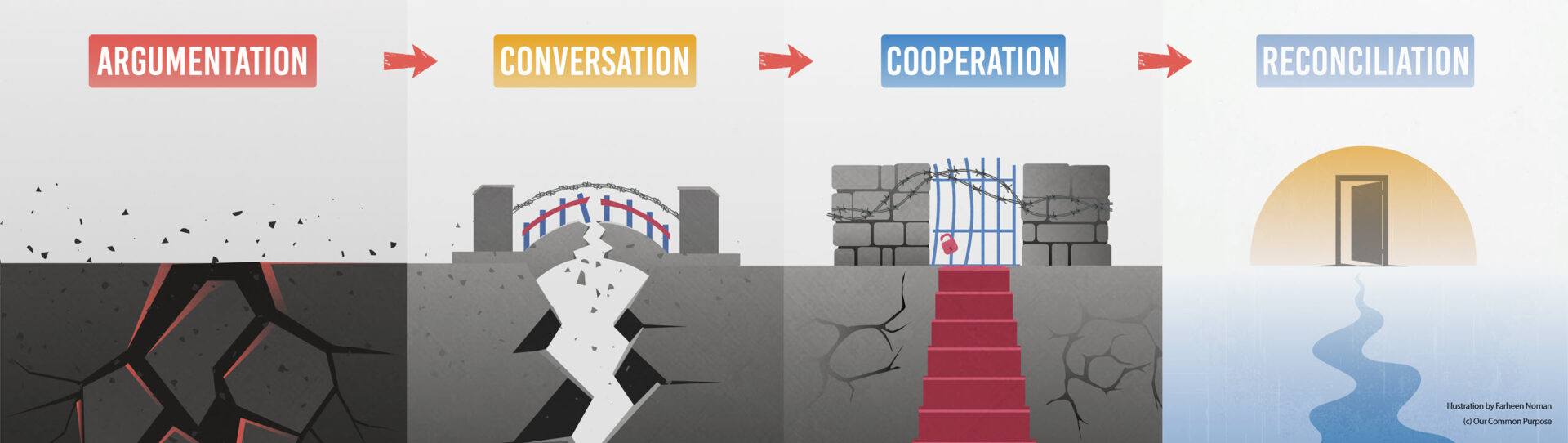
The to and fro since his death has brought me to realize there isn’t a simple on-off switch between arguing and cooperating. The dichotomy I had in mind isbetter thought of parts of a progression, with argumentation as the base stage. We can’t let this be the end state. We should progress from there to conversation, and from there to cooperation. In the ideal world, we would eventually get to reconciliation. That might seem a bridge way too far but the distance from here to there should not stop us from seeking to traverse the other steps.
To probe into this just a little:
Argumentation
Where we are stuck today and, unfortunately, where we may stay. To many, argument is inevitable and inescapable. We see ourselves as right, the others as being wrong. We disrespect them, if not something worse. We know it all, they know little. We argue with no intention of changing our minds.
The President said at Sunday’s memorial service for Kirk: “No side in American politics has a monopoly on disturbed or misguided people but there’s one part of our political community which believes they have a monopoly on truth, goodness, and virtue, and concludes they have also a monopoly on power of thought or speech.”
The accusation is worthy of some serious self-reflection. But the greater truth is that both sides need to be looking in the mirror.
The most unbending advocacy is built on conceit, self-righteousness, and the convictions that arise from one’s own bubble. Folks claim to know what the other side is thinking on most any subject – when they really don’t. The other side, which in reality is a patchwork of viewpoints, is stereotyped in the extreme.
Conversation
A big step up from argumentation, in that it begins with a real interest in learning the other person’s point of view. Exploring what’s necessary to achieve a useful conversation is itself a worthy subject of examination. Certainly easier and better if the two parties have some level of respect for each other, and with that the desire to hear each other out. That involves truly listening, and responding in a way that shows the other person was heard, rather than straying off point to one’s own next thought. Conversation won’t by itself solve the problems of the world but it’s a step toward understanding.
Cooperation
Another step forward, moving from interest to intention. Once mutual interest in communication has been established, it becomes easier to deliberately structure the dialogue toward some desired outcome. E.g., what on this topic do we agree about, what do we disagree about, how should we proceed from here? This is not to suggest that the two parties will suddenly agree. It does mean they will deliberately suspend judgment while they work through the possibilities. One structured process for doing this, called polarity management, has been thoroughly explored on this site this year.
Reconciliation
With enough of the above, one might hope for some eventual meeting of the minds. This could end up being a crowning achievement, although getting there is far in the distance. We can’t let the enormity of that challenge keep us from advancing on the previous stages.
Not to suggest any part of the progression is easy. Reaching across the divide is hard to accomplish. Our present-day turmoil makes it all seem improbable if not impossible, but we cannot default to argument. Unless we start taking steps toward a better day then that day will never come.
With the outpouring of grief and tributes at his memorial service now complete, may Charlie Kirk rest in peace. For the good of the country, the rest of us need to begin arranging a peace of our own.
— Richard Gilman
We need perspectives such as this to keep us hopeful and motivated to find a path to reclaiming what our country has stood for. Please continue the conversation.
Thank you,
Bravo, Richard! No more zero sum mentalities. Instead, total surrender of ego to make room for true listening, common solutions, and win- win outcomes. This is possible! You have outlined a wise path.
Marilyn, I admire how you phrase this. You’re totally right. These days we’re caught in a zero-sum paradigm. We have to find a way to change that.