
A Tip of the Cap to Respecting the Flag
Sept. 7, 2025
This is a tale about a cap, a cap with a patriotic twist.
I spotted it in a touristy-kind-of gift shop the other day. The khaki cap offers a nod to Boston on the edge of the brim, with USA displayed on the side. Much more noticeably the front panel sports the American flag in shiny white, charcoal and black. There’s not a hint of red or blue anywhere.
While I recognized some might see it as irreverent, I liked the subdued color scheme. To me anyway it softened the prominence of the flag. I was intrigued enough to ask my wife Wendy if she liked the cap. She did not.
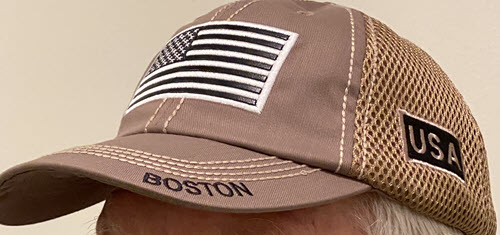 You read two weeks ago about the dialogue between the two of us. Our custom of trying to arrive at some consensus, and guide our actions accordingly, doesn’t usually extend to our choice of apparel. Nonetheless, in the moment I accepted her verdict on the cap.
Wendy’s objection wasn’t about fashion. No matter the colors, she believes our flag has become too politicized.
In her mind MAGA hijacked the flag in the run-up to the 2024 election. American flags, many of them mounted next to Trump pennants, loudly whipped in the wind as rallies of pickup trucks rolled through city streets. No telling how many flags got shredded along the way but the commotion screamed the drivers’ evident regard for themselves as the true patriots in this country. It stuck in Wendy’s craw.
MAGA is hardly the first to exploit the flag for political purposes. The liberal counterculture has used it as a form of protest for many years. Flying the flag upside down. Burning or otherwise desecrating the flag over the Vietnam War, the policies of Ronald Reagan, Black Lives Matter, and so forth.
Our visit to the gift shop happened to come just a few days after President Trump issued an executive order, another in his continuing stream of executive orders, that takes exception to recent protests including those this summer in Los Angeles. A White House fact sheet complained the protests “featured flag burning alongside violent acts and other conduct threatening public safety.”
In response, the executive order seeks to “restore respect, pride, and sanctity to the American flag and prosecute those who desecrate this symbol of our freedom, identity, and strength to the fullest extent permissible.”
The order is largely for show. Prosecution to “the fullest extent possible” likely amounts to very little, in that the Supreme Court ruled in 1989 that flag burning is political expression protected by the First Amendment. Trump is not concerned so much about prosecution as he is about fanning the passions that he knows burn among the faithful.
A few years ago, one of the polls conducted by Our Common Purpose tested public perception of which traditions and institutions unite or divide us. “National symbols (e.g. the American flag)” finished a respectable 10th of the 28 possibilities.
Support though was not evenly distributed. The flag did well among older folks. It did less well among young people, those who rely on social media, and blacks. More germane here, it did well among conservatives and, in an overlapping demographic, among Republicans. It did less well among liberals and Democrats.
Sociologist Jonathan Haidt helps explain why in “The Righteous Mind,” his seminal work about how conservatives and liberals differ in their moral foundations. Early in the study, he sought reactions to a story about a woman who cut up an old flag to make rags. He reflected: “I also began to understand why the American culture wars involved so many battles over sacrilege. Is a flag just a piece of cloth, which can be burned as a form of protest? Or does each flag contain within it something nonmaterial such that when protesters burn it, they have done something bad?”
Haidt found sanctity is among the strong moral foundations for conservatives. Not so much for liberals.
Flag-burning protesters manage to quite vividly display their fury at the country letting them down, but they do themselves or their causes no favors. They would win more sympathy, and support, if they reversed their approach. Carrying the flag at their vanguard, in much the same manner as it is mounted on pickup trucks at Trump rallies, would send the message: “We are proud Americans, too. We deserve to be treated as such.”
My wife is absolutely correct. The flag doesn’t belong to one side or the other. It belongs to all of us.
The ultimate test is whether we treat it respectfully, which explains why I hesitated at the gift shop. Ever since the red, white and blue format was decreed by the Flag Act of 1777, Betsy Ross and her many successors have abided by the tradition. The purists likely won’t think of it this way, MAGA might not think of it this way, you might disagree, but the cap to me tastefully portrays patriotism without being too much in anyone’s face. No matter the colors, it honors the stars and stripes.
Having considered all of the above, with or without my wife’s blessing, days later I returned to the gift shop to purchase the cap.
— Richard Gilman
Hi Richard:
Your posting was successful in making me think about our American flag and what it means.
My first reaction is that a black and white stars and strip flag is not an American flag. Flags are composed of color shapes and symbols. The colors of the American flag are as important as the shapes and symbols on it. So I conclude you are not wearing a cap with an American flag on it.
However, that may be a rushed judgment on my part.
You made me wonder what a black and white stars and striped flag does represent. A quick search turned up this explanation: https://www.wikihow.com/Black-and-White-Flag-Meaning
You may be making a more political statement than you realized with your new cap from Boston.
Monica